

Quick Takeaways
- Sourcing is rarely where the days go. The gap between a profile arriving and someone deciding on it is the largest single block of dead time in most processes.
- Candidate tolerance for slow hiring is rising, so delay no longer shows up as visible drop-off.
- That makes it more dangerous, not less: your fill rate looks fine while the quality of who accepts quietly drops.
- Only one in five companies measures quality of hire, so almost nobody catches it.
- A written feedback window with the hiring manager moves the number further than any sourcing change.
The role has been open since January
You approved the headcount in January. It is now April, the role is still open, and your recruitment partner keeps sending profiles. The obvious conclusion is that the market is tight and good people are hard to find.
Sometimes that is true. In India right now, it is less true than it used to be. Naukri’s JobSpeak index recorded white-collar hiring growing 8% across FY26, the strongest year in three, with AI and machine learning roles up 33% year on year. If your roles are taking longer than they did two years ago, the market alone does not explain it.
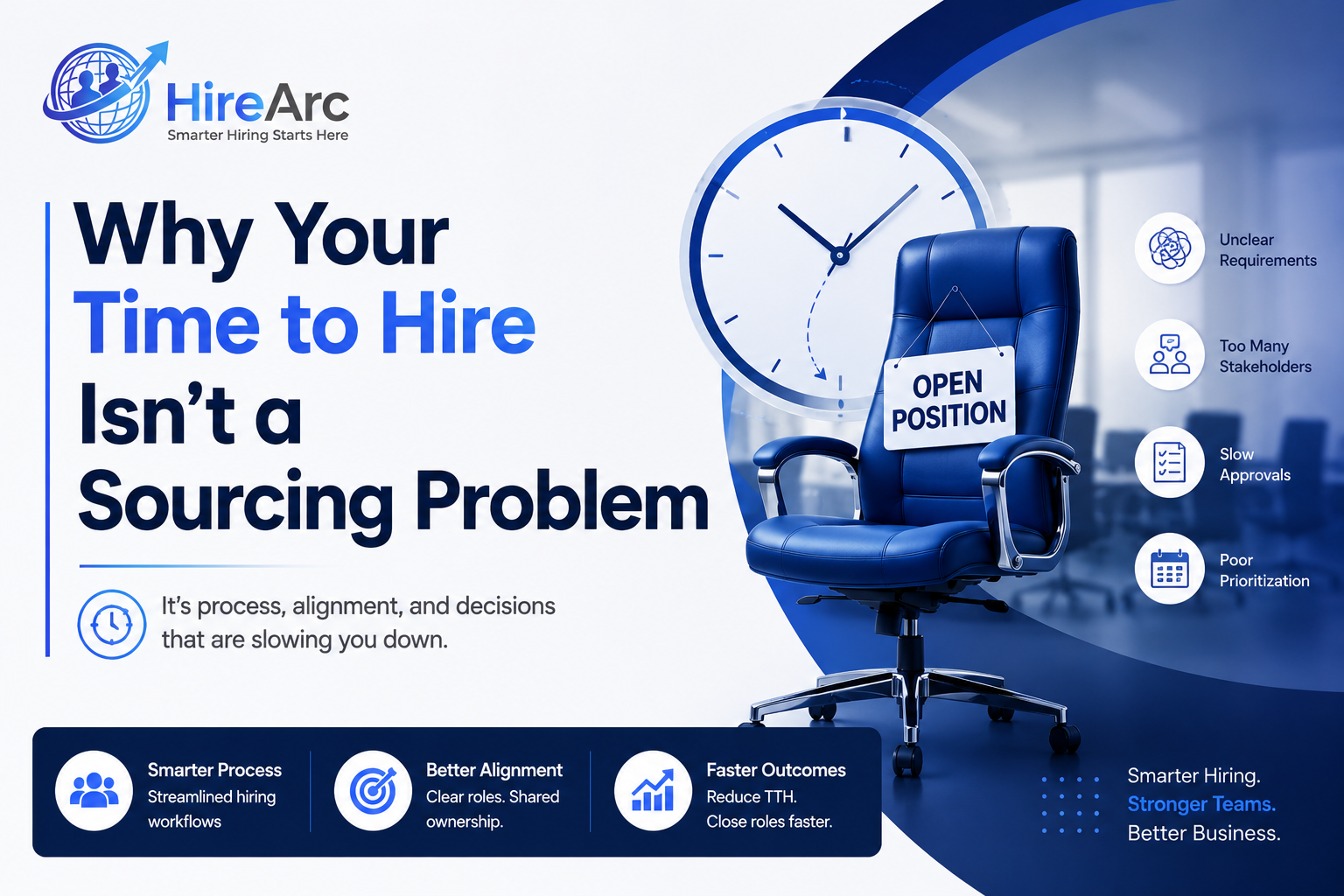
Here’s the reality: for most companies, a long time to hire is not caused by sourcing. The days go missing in the gaps between stages the ones nobody owns and nobody measures. This article breaks down where that time actually sits, what a slow process costs you in 2026, and the three changes that move the number.
What Counts as Time to Hire, and What Most Teams Measure Instead
Before you can shorten the number, you need to agree what it is.
Most benchmark figures use requisition-to-acceptance: the day the role is approved to the day the candidate says yes, in calendar days including weekends. Most internal teams measure something narrower first profile received to offer released because that is what their ATS reports by default.
The two can differ by three or four weeks, and the difference is almost entirely internal approval time and post-offer negotiation. Neither is wrong. But if your agency reports one time to hire figure and your CFO quotes another, you will spend the meeting arguing about arithmetic instead of the process. Agree the definition first. Our guide to recruitment metrics and KPIs covers how to set this up so it survives scrutiny.
How Long Should Hiring Take in 2026?
For non-executive roles, roughly 39 calendar days from requisition to acceptance; for executive roles, about 45. Those are the 2026 medians from SHRM’s recruiting benchmarking data, based on 4,657 respondents, and non-executive time-to-fill has come down from 44 days the year before.
Two caveats matter, and most articles skip both. First, SHRM’s sample is drawn from US organisations, and no India-wide benchmark is published to the same standard. You will find plenty of pages stating that Indian hiring averages 35 to 45 days we could not trace any of them to a primary source, so we are not repeating the figure.
Second, benchmarks disagree depending on what they count. Employ’s 2025 data put the average at 63.5 days to fill an open position, against SHRM’s 39-day median for the same period. Both are credible; they measure different things across different samples. Use them as reference points, not targets, then measure your own last ten closed roles.
Where the Days Actually Go
Map a stalled role stage by stage and the pattern is consistent the stages you control are quick, and the stages nobody owns are where the weeks disappear.
| Stage | Typical elapsed time | Who controls it |
| Sourcing and screening | 3–7 days | Recruiter |
| Profile sitting awaiting review | 3–14 days | Hiring manager |
| Scheduling each interview round | 7–21 days | Nobody, usually |
| Interview and evaluation | 1–2 days | Hiring manager |
| Offer approval and release | 3–10 days | Finance and HR |
Two of the five stages account for most of the calendar, and neither of them involves anyone assessing a candidate.
Sourcing is rarely the bottleneck
Volume is usually not the constraint. In one recent week across a single client portfolio, our team submitted 53 profiles, which produced 8 shortlists and 6 scheduled interviews. The pipeline was not empty. It was moving slowly.
If you are planning headcount, work backwards from a ratio like that rather than from optimism. And if your recruiter is submitting steadily while your shortlist stays flat, the constraint sits downstream of sourcing.
The feedback gap
This is the one that costs most, and it is the one we see most often in our own delivery.
The single most common reason a role stalls is not candidate supply. It is the gap between a profile landing in an inbox and someone deciding whether to interview. We currently have live escalations recording hiring managers sitting on submitted profiles for two weeks while those candidates were flagged as immediate joiners. In that window, an immediate joiner has almost always accepted somewhere else.
Nobody in that chain did anything obviously wrong. The hiring manager was busy shipping, the recruiter chased twice, and the candidate simply moved on. That is what makes this failure mode so persistent it never looks like a failure while it is happening. Our breakdown of common bottlenecks in the hiring process covers the others worth auditing.
Scheduling multiplies everything
Every round has a scheduling gap in front of it, and those gaps compound. Cronofy’s candidate expectations research, which surveyed 12,000 candidates, found that only 9% got a first interview scheduled within a day, while 31% waited two to three weeks for that first slot alone.
Multiply a two-week scheduling gap across three rounds and you have added six weeks before anyone has evaluated anything. This is also the least defended part of the process no one is accountable for a gap that sits between two calendars.
Do Slow Hiring Processes Still Lose You Candidates?
Less often than they used to and that is worse news than it sounds.
Cronofy’s data shows 42% of candidates leaving a process because scheduling took too long, down from 49% the previous year. More candidates now say they would wait a full month before disengaging. As the market has softened, people have become more willing to tolerate a slow process.
Here’s where most companies get it wrong. They read a stable fill rate as evidence that their hiring is healthy. What has actually happened is that the signal disappeared. Candidates with no other options wait. Candidates with three live processes and a counter-offer do not and the same research found 70% of candidates weighing how smooth the process felt when choosing between competing offers.
So delay has stopped costing you headcount and started costing you the top of your shortlist. You still fill the role. You fill it with your third choice, and nothing in your dashboard tells you that happened. SHRM found only 20% of organisations measure quality of hire at all, which is precisely why this goes unnoticed for years.
What Actually Moves the Number
Put a feedback window in writing
Agree a fixed turnaround 48 to 72 hours on every submitted profile with the hiring manager before sourcing starts, not after the first complaint. Written commitments hold; verbal ones evaporate the first busy week.
Cap the number of vendors
Running five agencies on one role does not give you five times the candidates. It gives you the same candidates five times, and a candidate who now knows five people are pitching them the same job. We see duplicate submissions collapse pipelines on exactly these mandates. Two vendors, working exclusively enough to care, will outperform five competing on speed alone.
Fix scheduling before you fix sourcing
It is the cheapest change available and almost always the largest. Pre-block interview slots weekly. Let candidates self-select from open times. SHRM found that organisations with the most effective recruitment practices fill roles about five days faster than everyone else, and scheduling discipline is a large part of that gap. Our notes on improving hiring efficiency go into the practical mechanics.
Check whether the maths actually closes
Sometimes the process is fine and the capacity is not. Recruiter workloads rose to a median of 25 open requisitions each in 2026, up from 20 the year before, and more than two in three organisations report struggling to fill open roles. Two recruiters carrying thirty roles will be slow no matter how disciplined the process is. That is the point at which an RPO arrangement is worth pricing against the cost of missing the quarter.
Frequently Asked Questions
What is a good time to hire for a mid-level role?
Use 39 calendar days from requisition to offer acceptance as a working reference, based on SHRM’s 2026 median for non-executive positions. Senior and niche technical roles run longer. More useful than any benchmark: measure your own last ten closures and find your baseline.
Why is our time to hire getting longer when we have more applicants?
Application volume and hiring speed are barely related. Extra applicants add screening load without moving decisions any faster. If volume is up and the number is worse, the constraint is decision speed, not supply.
How much does interview scheduling really add?
Enough to dominate the total. Across three interview rounds, the waiting time in front of each round routinely exceeds every other stage combined including sourcing, evaluation and offer approval.
Does hiring faster mean lowering the bar?
No. Speed comes from removing dead time between stages, not from shortening evaluation. Cutting a two-week feedback lag does not reduce interview rigour by a single question.
Should we use more recruitment agencies to fill roles faster?
Usually the opposite. Beyond two vendors you get duplicate submissions, candidates approached repeatedly about one job, and no partner invested enough to work the role properly. Fewer vendors with a real feedback commitment closes faster.
What single change makes the biggest difference?
A written feedback commitment from the hiring manager on every submitted profile. It costs nothing, needs no new software, and removes the largest block of dead time in most processes.
The bottom line
Your time to hire measures how quickly your organisation makes decisions, not how quickly your recruiter finds people. Feedback lag and scheduling gaps are almost always the constraint.
The trap in 2026 is that candidates have grown more patient, so a slow process no longer announces itself through visible drop-off. It shows up later, in who accepted and how they performed and if you are among the 80% not measuring quality of hire, it may never show up at all.
Start by mapping your last ten closed roles stage by stage. The bottleneck is usually obvious within an hour, and it is usually sitting in someone’s inbox.
How The HireArc Can Help
If your hiring is stalling on decision speed rather than candidate supply, that is a process problem, and process problems are fixable. We work with founders and HR leaders across India on permanent hiring, contract staffing, RPO, and executive search and we start by mapping where your current process actually loses time, before proposing anyone.
If you have a role that has been open longer than it should be, tell us where your process is losing time and we will walk through the timeline with you.

With over a decade of experience in talent acquisition, strategic workforce planning, and compliance-driven recruitment, Suraj has a deep understanding of the HR landscape — from emerging gig models to enterprise-level staffing solutions. His expertise lies in translating complex hiring challenges into actionable, scalable strategies that drive both performance and retention.
What truly sets Suraj apart is his critical thinking approach to solving hiring bottlenecks. Whether it’s identifying inefficiencies in the recruitment pipeline or designing adaptive hiring frameworks, he applies structured reasoning, behavioral analysis, and market intelligence to deliver sustainable solutions.
Beyond recruitment, Suraj is passionate about bridging the gap between business intelligence and human potential, fostering data-backed HR strategies that empower organizations to make smarter hiring decisions.
- How Many Recruitment Agencies Should You Use? - August 10, 2026
- Why Your Time to Hire Isn’t a Sourcing Problem - August 6, 2026
- Insightful Questions to Ask Hiring Managers During Interviews - November 9, 2025
